Charlotte Brontë’s Brussels
After we moved to Brussels last year, my thoughtful husband gave me a copy ofThe Brontës in Brussels by Helen MacEwan. This is a very interesting account of the time Charlotte and Emily Brontë spent starting in 1842 at a boarding school, a pensionnat, for young girls and ladies here. The Brontë sisters were already grown up; they came to learn French, which they believed would be useful to them when they set up their own school (something they never managed to do; instead, they wrote a few extraordinary novels and died quite young).
Emily left after one semester, but Charlotte staid a year more and apparently fell in love with a happily married professor at the school, her French professor and the schoolmistress’ husband. He became the basis for the character of Monsieur Paul Emanuel in her novel Villette. I decided to read the novel — her first, written before Jane Eyre. It is very closely based on her experiences in Brussels, and takes place largely at a school for girls in the heart of the city. She calls her fictional version of Belgium Labassecour, which is a pretty funny/insulting name since it means “farmyard” in French.
The school Emily and Charlotte attended and its large enclosed garden are gone today, as is the street it stood on, Rue Isabelle, which is underground now (you can see part of it preserved in the subterranean museum of the Palais du Coudenberg). But after reading MacEwan’s book, one can visualise exactly where some of the scenes in Villette take place, such as the early one in which the friendless and penniless Miss Lucy arrives in the city, makes her way through a dark park and down a flight of stairs, is harassed by strange men in the street, and finds her way to the pensionnat where she will find employment.
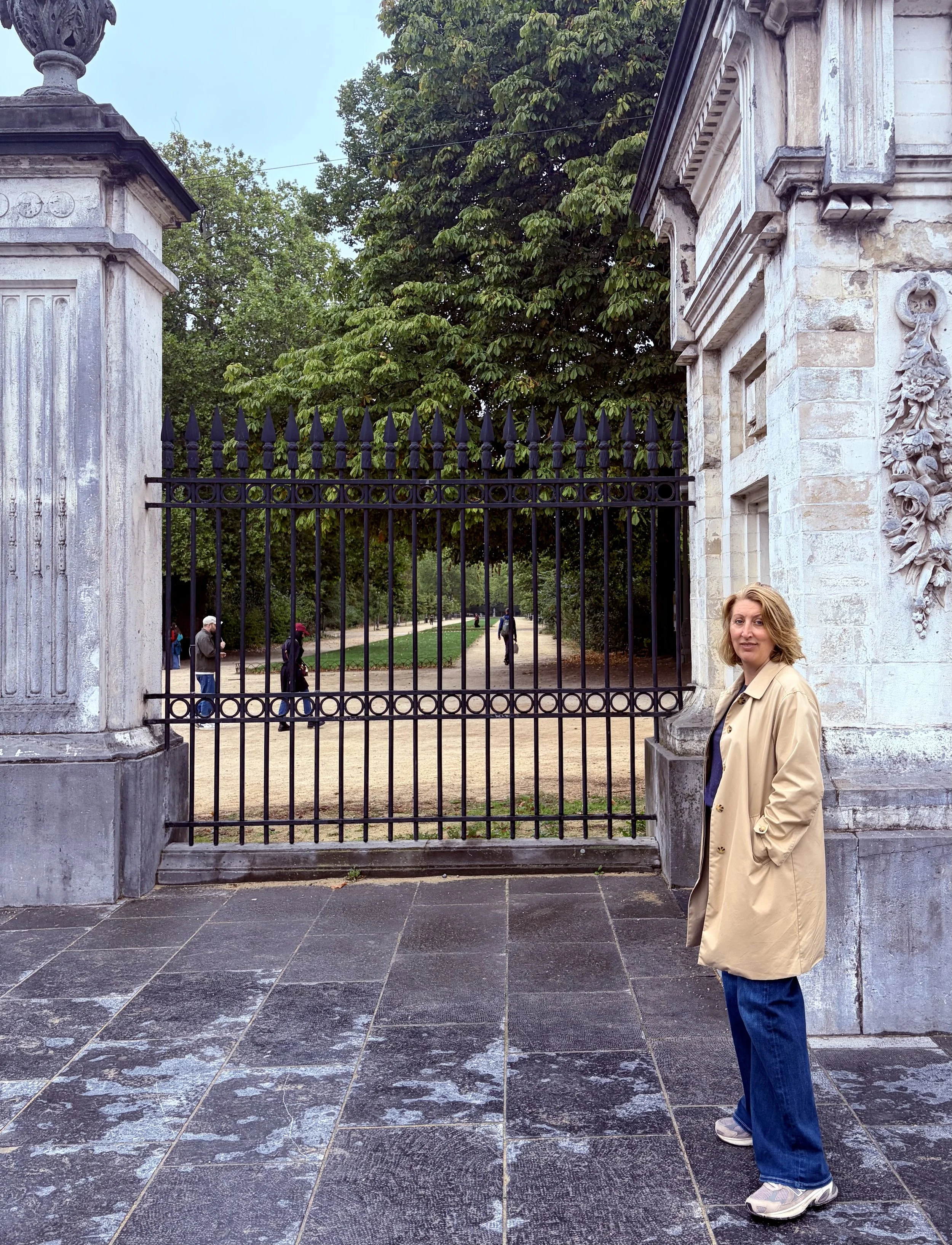
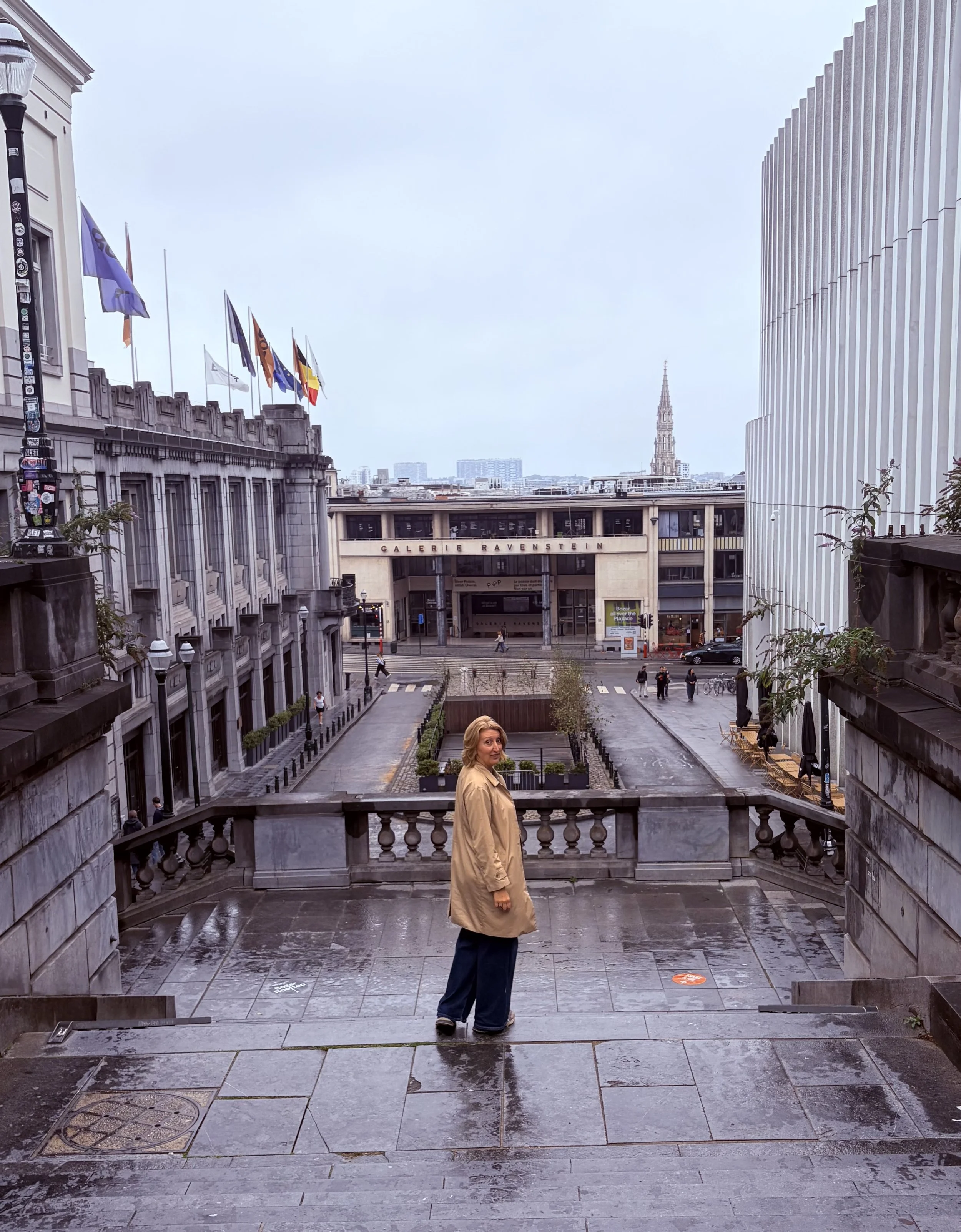
(The park is the Parc Royale and there are still steps, along the Rue Baron Horta, leading to the Galerie Ravenstein and the corner where the Bozar arts center stands today. MacEwan does walking literary tours of Brussels and her book has wonderful maps and illustrations).
In many ways Villette is a flawed debut novel; it is overly long and has little plot to speak of. Not much happens in it except often small emotional dramas; the central relationship, which should by all rights be a love story between Miss Lucy and Monsieur Paul, is all angst and anticipation and misunderstanding and very little action. This first book does not have the focus, emotional cohesion and dramatic twist and turns of a great work like Jane Eyre. But it still shows an impressive talent and ambition. Bronte wrings her limited life experience for all it is worth, bringing to bear her considerable powers of observation and imagination.
I want to quote from one passage at length because it exemplifies some of the book’s fundamental and overlapping aspects: its ironic energy (which I like better than its romantic and gothic élans, although they aren’t bad either); Lucy’s honesty, pragmatism and independence; and the author’s view of what makes good art. One day Lucy visits a gallery of paintings:
One day, at a quiet early hour, I found myself nearly alone in a certain gallery, wherein one particular picture of pretentious size, set up in the best light, having a cordon of protection stretched before it, and a cushioned bench duly set in front for the accommodation of worshipping connoisseurs, who, having gazed themselves off their feet, might be fain to complete the business sitting: this picture, I say, seemed to consider itself the queen of the collection. It represented a woman, considerably larger, I thought, than the life. I calculated that this lady, put into a scale of magnitude suitable for the reception of a commodity of bulk, would infallibly turn from fourteen to sixteen stone.® She was, indeed, extremely well fed: very much butcher's meat - to say nothing of bread, vegetables, and liquids - must she have consumed to attain that breadth and height, that wealth of muscle, that affluence of flesh. She lay half-reclined on a couch: why, it would be difficult to say; broad daylight blazed round her; she appeared in hearty health, strong enough to do the work of two plain cooks; she could not plead a weak spine; she ought to have been standing, or at least sitting bolt upright. She had no business to lounge away the noon on a sofa. She ought likewise to have worn decent garments; a gown covering her properly, which was not the case: out of abundance of material - seven-and-twenty yards, I should say, of drapery - she managed to make inefficient raiment. Then, for the wretched untidiness surrounding her, there could be no excuse. Pots and pans - perhaps I ought to say vases and goblets - were rolled here and there on the to say vases and goblets - were rolled here and there on the foreground; a perfect rubbish of flowers was mixed amongst them, and an absurd and disorderly mass of curtain upholstery smothered the couch and cumbered the floor. On referring to the catalogue, I found that this notable production bore name ‘Cleopatra.’
M. Paul arrives, but he is struck by something else altogether — that Lucy is there by herself, and that she should be looking at a picture that displays a largely nude female body.
“Astounding insular audacity!” cried the Professor. “Singulières femmes que ces Anglaises!”
“What is the matter, monsieur?”
“Matter! How dare you, a young person, sit cooly down, with the self-possession of a garçon, and look at that picture?”
“It is a very ugly picture, but I cannot at all see why I should not look at it.”
One thing I find fascinating about Villette is the degree to which it a story of culture clash. There is a great emphasis on the cultural differences between the British and “continentals” (and the obvious superiority of the British) in terms of taste, morals, and manners, with a particular emphasis on the fact that British women are more honest and independent. The propensity of British women to travel alone (as Lucy does, leading to somewhat harrowing experiences) is remarked upon repeatedly.
Generally the Labassecouriens are described as overly emotional, with a tendency to be dishonest and with no strong inner moral compass. This is partly ascribed to religion — Catholicism is seen as a religion that teaches subservience to external authority, which is exercised through constant surveillance. The headmistress of the school where Lucy works, the remarkable Madame Beck, is a perfect example of this: charming, clever, cold, entirely self-interested, given to spying constantly on her pupils and staff.
And yet Brontë complicates this in a number of ways. There is a memorable scene in which Lucy, sick and lonely and in great mental and emotional distress, enters a confessional with a sympathetic Catholic priest, tells him she is Protestant, and unburdens herself. There is also the fact that she falls in love with M. Paul, who in addition to being Catholic has a number of other character flaws. These include a passionate, impetuous nature and a great desire to dominate others and be the center of attention; Lucy notices these faults from the very start and also finds them utterly endearing (which I find endearing in Lucy).
It is quite painful to read Bronte’s fictionalized, idealised version of Lucy and M. Paul’s relationship alongside the letters that Charlotte wrote to the real M. Paul — the Belgian professor Constantin Heger — after leaving Brussels (which McEwan quotes). Charlotte’s desire to maintain contact with her former teacher seems to have been only sharpened by his reluctance to engage with her. This is from one of the last letters she wrote to him, after several previous ones begging for a word from him had gone unanswered:
I know that you will lose patience with me when you read this letter - You will say that l am over-excited - that I have black thoughts etc. So be it Monsieur - I do not seek to justify myself, I submit to all kinds of reproaches - all I know - is that I cannot - that I will not resign myself to the total loss of my master's friendship - I would rather undergo the greatest bodily pains than have my heart constantly lacerated by searing regrets.
If my master withdraws his friendship from me entirely I shall be absolutely without hope - if he gives me a little friendship — a very little - I shall be content - happy, I would have a motive for living - for working.
Monsieur, the poor do not need a great deal to live on - they ask only the crumbs of bread which fall from the rich men's table - but if they are refused these crumbs - they die of hunger - No more do I need a great deal of affection from those I love - I would not know what to do with a whole and complete friendship - I am not accustomed to it - but you showed a little interest in me in days gone by when I was your pupil in Brussels - and I cling to the preservation of this little interest - I cling to it as I would cling on to life.
Perhaps you will say to me - I no longer take the slightest interest in you Miss Charlotte - you no longer belong to my household - I have forgotten you?"
Well Monsieur tell me so candidly - it will be a shock to me - that doesn't matter - it will still be less horrible than uncertainty.
I don't want to re-read this letter - I am sending it as I have written it - Nevertheless I am as it were dimly aware that there are some cold and rational people who would say on reading it - ‘she is raving' - My sole revenge is to wish these people - a single day of the torments that I have suffered for eight months - then we should see whether they wouldn't be raving too.
One suffers in silence so long as one has the strength and when that strength fails one speaks without measuring one's words too much
I wish Monsieur happiness and prosperity.
These are the overwrought missives of a person inexperienced in love, trying to will into existence a relationship that only exists in her mind; it is perhaps no surprise that the older, married man who received them seemingly decided it was best not to answer them. Poor Charlotte. But even without the “friendship” she craved, she very much did find motive for living and working; she took her experience, her fantasies and all her thwarted emotion and eventually made something astounding out of it.